In class we had to write a 50 mark analysis on a clip of Doc Brown, a show about a London Doctor who starts a new job in a medical practise in the countryside.
We had to show how the clip represented regional difference through
Sound
Mise-En-Scene
Camera Shots
Editing
The clip used all of these techniques to effectively represent regional difference through various different methods.
Sound was used through accents to show how different the people in this new town were to the Doc.
Camera Shots were used to effectively show off the countryside which is a new/unknown area for the Doc.
Miss-En-Scene was used a lot to show regional difference through the characters clothing and the characters attitude.
Editing was used to show how hectic his new start up was through lots of quick cuts in scenes where a lot of things go wrong at once.
Film the opening sequence of a new fiction film, including titles and soundtrack to last approximately two minutes.
To plan this opening sequence my group and I created a story board for the opening sequence which shows a rough outline of the direction we wish to take the sequence in; for example, it includes camera shots, locations, character marks and props. We will also add soundtrack notes to give a general idea of what sounds we would like to use in this sequence.
This opening scene needs to give enough story to give the viewer an idea of what the whole film would be about, but it can't give away too much story as it is only meant to create suspense and draw the viewer into the film.
This sequence needs to include a variety of camera shots to show the skills that our group has picked up; we also need to show off our editing techniques by making sure we follow certain rules like the 180 degree rule or the Rule of Thirds.
My group pitched our idea in front of our class. We gave what is called an 'elevator pitch' which is essentially a brief synopsis of our opening sequence that we can present in a short space of time. This pitch gave the story to our opening sequence, we also provided a mood board that is filled with pictures that describe the atmosphere we wish to have in our opening sequence.
After we gave our pitch, our class asked us questions about the opening sequence such as:
Where will the film be set?
It will be set in various locations, but we have an idea of what we need. We need a dark alleyway and possibly two rooms the the two main characters reside in.
How many people will you need to act in the opening sequence?
We only need two; a man in a suit and a mugger.
What vibe do you want your opening sequence to give off?
We would like our opening sequence to give off an eerie vibe that sets up a mystery/thriller type story, similar to Denis Villeneuve's Prisoners. We are still currently working on the script for the opening sequence and we are yet to finalise every aspect of the sequence itself, the creative process is a difficult one as all the members of our group have diverging ideas and opinions; although we agree that they are good ideas, it is difficult to fit these into the same opening sequence as they give off different vibes and change the story quite a bit.
We have been studying opening sequences of films for ideas to use in our main task of creating our own opening sequence. We studied what clips the sequence decided to show and especially what sound that the sequence use.
I feel like se7en is a perfect example of a good opening sequence as it perfectly sets up the vide for the rest of the film. It gives off a creepy unsettling feeling to the viewer as they watch troubling clips involving the use of hands.
The opening sequence also has a perfect use of music, the use of this disjointed and distorted music gives of a frightening vide to the viewer which, again, gives off the perfect vibe for the rest of the film.
The opening sequence also has an interesting use of font with the scratchy look that gives the viewer a feeling of fright which ultimately describes to the viewer what genre this film is.
The opening sequence for the film Dinner For Schmucks also uses hands throughout the whole opening sequence, but it gives off a completely different vibe with the clever use of colour and music.
The use of music is very important in this opening sequence because it perfectly sets up the rest of the film as the majority of it gives off a positive vibe (as does the character throughout the film) however, throughout the rest of the film there are moments of sadness which are shown through the chorus of the song which takes a more gloomy turn which are representative of later moments of the film.
The lyrics also play a big role in setting up the rest of the film; the chorus mentions being a 'fool on the hill' and being 'alone on the hill' which represents the main character as an outsider and a 'fool'.
The musics (mostly) positive tone plays a big role in creating the mood of the opening sequence as what is actually happening on screen is actually fairly odd and could give off a completely different vibe under different circumstances.
We watched a clip from the TV series Merlin and analyses how miss-en-scene was used to represent different class and different social status. The setting in this clip was a medieval style castle which shows instantly that there will be a range of different class and status. We saw Merlin who is a peasant get into a fight with Arthur, who is of a much higher class. Their class is highlighted by their clothing; Merlin was wearing a ragged t-shirt and jacket along with ripped trousers to emphasise his lower class. In contrast, we saw Arthur who was wearing a bright red tunic with plates of armour on him for protection, this immediately reveals his higher class to the audience as it shows that he is able to afford better clothing and protection.
The colour of clothes plays a big role in representing the difference in class and status. Poorer, less important characters (on a scale of social status and not on importance to the show itself) are usually shown wearing blandly coloured clothes that are usually damaged. Whereas characters of a higher social class are usually shown in brighter colours to show that they are richer.
The lighting also gives a good representation of the difference in class and status by showing Merlin in a room (that he is not supposed to be in) as dark until the royals walk in, where the room becomes much lighter to show how much richer they are than Merlin. However, when outside there is no lighting apart from natural lighting from the sun; this is to show how the peasants are of a much lower status.
Props also highlight key differences between the two sets of characters. In the clip when Merlin is in the castle, we see various expensive items like stone pillars, huge wooden tables, and big glass mirrors. In contrast, we see the peasants village where there are makeshift homes and fireplaces with cheap cooking equipment. The higher living standards of the rich emphasise their higher class and status compared to the poor peasants.
We watched a movie scene from L.A. Confidential that really emphasised the importance of camera shots and editing.
The Clip:
The clip starts with a tracking shot of the two detectives walking into an office. This part is very important and highlights the importance of camera work because it shows people that haven't seen the film before who the important characters are; even though these two detectives burst into a mans office unannounced and violently beat a man, the audience is still supporting these two characters because of how they were shown in the beginning of the clip.
Multiple camera shots are used in the scene to show everyones emotions; the two detectives are shown as strong , but with bland facial expressions whereas the man being interrogated is shown as first being confused, then cocky and finally terrified as he is hung out the window.
Editing describes the relationship between shots and the process by which they are combined. The relationship between shots can be graphic, rhythmic, spatial and/or temporal.
There are different types of editing which can include:
Sound Editing - Where sound effects are added to a scene after shooting to make the scene more immersive for the audience to watch.
Continuity - Where several shots appear together and all link with each other, this creates a situation in which the audience shouldn't be able to tell that it wasn't filmed in fragments.
Montage - These are used to pack clips into a short space to show the passage of time or to recap what has previously happened in a film or show.
Transition - A transition is where the director moves from one shot to another, there are different types of transitions/cuts that include the straight cut, fade out and face up.
Dissolve - This is where one image gradually replaces another in one smooth transition.
Wipe - This is where one image is replaced by another without using the dissolving effect, this effectively eliminates the first shot and replaces it with another.
The aim of our preliminary task was to create a scene in which a character walk through a door (which must be shown from both sides to highlight continuity) and has a short conversation with another character.
This scene was important to make because we needed to emphasise the Rule Of Thirds and The 180 Degree rule.
It was extremely important to maintain continuity, this factor was made difficult due to the fact we had to film the scene on two different days.
We had to use a variety of camera shots and angles to show the skills we learnt in==about filming and camera work.
We learnt about different types of sound in Tv and how they are used to express/emphasise a scene. We learnt that sound is just as, if not more, important than the actual picture during TV/film, this is because sound allows the audience to use their imagination where as video shows the audience exactly what is happening.
Sound can be used as a simple backing track or to make it clear that the scene you are watching is important, it can be used to introduce characters and/or dismiss them.
Some different kinds of sounds that are used:
Diegetic - Diegetic sound is any sound that comes from a person or object that is within the field of view of the audience i.e. dialogue (dialogue are the words that characters say).
Non-Diegetic - Non-Diegetic sound can be any sound that comes from somewhere outside the viewers field of vision.
Direct Address - A direct address is when a narrator or character talks directly towards the audience instead of the other characters; this technique 'breaks the fourth wall' as it acknowledges the existence of the audience e.g. Ferris Bueller's Day Off.
Sings - Sings are short bursts of music, sometimes they are used to bump together different scenes.
Sound Bridge - A sound bridge is where a sound continues across one or more cuts/transitions.
Ambient Sound - Ambient sound are the sounds of the location that the camera is in e.g. water noises near a river or crows in a forest.
Asynchronous Sound - This is a type of sound where the sound is out of sync with the visuals or it can be completely unrelated to the visuals, this can be used to create the feeling of distortion.
Sound can be used as a backing track to make a scene more powerful or more important. Sound is often used in the show 'community' to provoke emotional reactions from the viewer:
A view from directly overhead to afford a clear view - sometimes used to emphasise the spectacle of a scene.
Canted Angle:
A shot which is tilted to one side; this is often used to create a feeling of distortion.
Close Up:
Close ups, including extreme, big and medium close ups; they are used to draw the viewer closer to a point of interest and to involve them in what is happening. Close ups can also be used to observe the emotions and reactions of certain characters. Close ups are important to privilege the main protagonist over other characters.
Crab Shot:
A crab shot is a type of camera shot in which the camera is placed in a confined space like a cupboard.
Crane Shot:
A type of shot where the camera is place on a specifically designed crane, which can be raised and lowered for different camera angles. A crane shot usually provides a high-angle shot, but it allows the director to swoop down to a low-angle shot at will.
Deep Focus:
A camera technique that allows objects both near and far from the camera to be in focus at the same time.
Establishing Shot:
An establishing shot is usually a wide or a long shot, and they are often used at the start of a programme or a film; sometimes during the start of a new scene. They can be used to establish a relationship between a character and a location or to show the characters whole view.
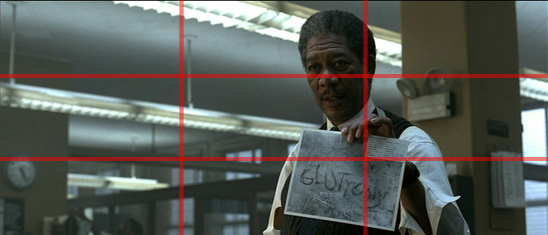
The basic principle behind the Rule of Thirds is to break down an image or video into thirds, horizontally and vertically, so that the video or image is split into 9 parts.
The idea is that if you place points of interest along where the lines meet, the photo/video becomes more balanced and will let the viewer to look at it more naturally.
Most TV shows and movies abide by the Rule of Thirds, but some don't to be purposefully artistic.
For example, MR. Robot by Universal Cable Company is a famous example that completely ignores the Rule of Thirds duringdialogue and for the most of the show.
In today's lesson we learnt about the history of editing and how editing can affect the viewer of a film.
Georges Melies was the first man to truly 'edit' a film in 1897 when he was filming a Bus, but during the film his camera jammed, when he fixed the camera the bus was gone and a Hurse was in its position. So when shown on film, the bus turned into a Hurse on screen. This would become the very first example of the 'Jump Cut'. Melies then used this feature to create disappearing and repairing effects in his movies.
Types of 'cuts' in Film
The Hard Cut: Means simply cutting from point A to point B.
The Jump Cut: A jump cut cuts from a frame in a clip to a later frame in the same clip or to a clip that looks very similar. In a stylistic format, a jump cut can mean different things; the passing of time or repetition over time. Commonly used in Action Films.
The J-Cut: J-cut means you hear the audio before you see the video that matches with that audio. It doesn’t mean you’re staring at a black screen. It just means you’re looking at clip A while hearing the audio from clip B.
The L-Cut: L-cut means you’re still hearing the audio from a shot but you’re seeing a new shot. The viewer is looking at clip B while still hearing audio from clip A.
The Popcorn Cut: Popcorn cutting, which is generally reserved for comedy, is very simple: If a character is talking, they are onscreen. There are no reaction shots while someone else is talking. An extreme version of popcorn cutting is that to show a character’s reaction at a key point in the middle of the dialogue, you show the reaction, break the dialogue, and then cut back to the character speaking. Popcorn cutting is also sometimes used in fast-paced dialogue.
The 180 Degree Rule
The 180 degree rule, camera position and eyeline. When you film a scene using separate shots, it's important that people understand where everything in the scene is. You could just show your scene in long shot, but that would mean we couldn’t see facial expressions, or details of what characters are doing. Using the same shot for a long scene of dialogue can also be very boring to the viewer, it's much more interesting to the viewer if you use multiple shots and show characters reactions.
Examples Of Good Editing
The Church fight scene in Kingsman: The Secret Service is one of my personal favourite movie scenes because of how well it is choreographed and the quality of the editing. I love this scene because I am able to see exactly what is going on and who he is fighting, unlike many modern fight scenes that use constant jump cuts and shaky camera to hide poor choreography and overall ruining the scene.
The final fight scene int The Raid 2 is also an extremely well done scene for the exact same reasons.
Examples Of Bad Editing
This scene in The Expendables is an example of bad editing during in a fight scene due to the over use of jump cuts and a shaky camera which hides the action from the viewer and is even slightly disorientating.